
The city that never sleeps is being kept awake by constant noise — but officials say they’re on the case.
Never a quiet town, the cacophony in NYC has in recent years reached a fever pitch — with complaints soaring nearly as high the Big Apple’s glass-shattering decibel levels.
In 2025, 311 logged an earsplitting 636,000 noise complaints, broken down into 463,349 residential complaints and another 173,049 street and sidewalk calls. On average, that’s 1,700 complaints per day.
While still slightly fewer than the over 700,000 recorded in 2025 — the most of any other complaint that year — that was still enough to leave New Yorker’s ears ringing.
The lion’s share were dedicated loud music and partying, while another chunk concerned banging, but there was also thousands of complaints lodged against “loud talking.”
While the racket might seem merely ear-ritating to some, long-term exposure can cause a symphony of symptoms, including hearing loss, stress, sleep disturbances, mental health issues and even cardiovascular effects, experts warn.
Putting the ‘wake’ in Wakefield
Much of NYC’s urban din is concentrated in one neighborhood: Community District 12 in The Bronx, which includes areas like Edenwald and Wakefield. The zone had 153,082 service calls between Jan. 1 and Dec. 31 of last year — nearly 100,000 more than the number recorded in the city’s second noisiest. In fact, almost all the 311 calls from that part of the borough pertained to noise.
In the past, residents of the district have cited loud shouting, fireworks and bass-holes cranking their car stereos up to sonic boom-box levels.
“It felt like the whole block was vibrating,” local Roy Bartley, 71, told Harlem View of getting jolted awake by a car speaker that reverberated so powerfully his window panes trembled.
District official Guy Torres attributed the rumbling in the Bronx to the “permissive” atmosphere — and to businesses that play loud music “right on the street,” the NY Times previously reported.
Brooklyn’s got bass
Coming in second on Gotham’s Mount Rushmore of auditory assault was Flatbush, Brooklyn, specifically zipcode 11226, which logged 50,918 calls to the non-emergency line.
Residents have found the clamor unbearable.
“I have a friend who lives near Flatbush avenue and Caton Avenue,” lamented one critic on Reddit. “I can not believe that that much noise pollution exists. I think they’re living in hell with all the honking and worse than that the vibrations coming from the trucks.”
Another wrote, “No floor is high enough. I live at least 3x higher (rather not mention my exact floor), also in one of those Flatbush adjacent buildings, and the noise is still ridiculous.”
Queens cacophony
Rounding out the top five spots were Williamsbridge and Highbridge, both in the Bronx, as well as Ridgewood, Queens, where one allegedly bad actor has has been repeatedly flagged for loud music emanating from the venue at all hours.
“Lottus Event Center at 6301 Fresh Pond Rd is at it again with another incredibly loud event that we can clearly hear from blocks away,” said one critic on Reddit. “Bass so loud and low that we can feel it, so earplugs and noise machines are no use.”
They added, “I’ve tried playing nice and contacting them so many times and they just do not give a s–t about the people who actually live and have families in the surrounding area.”
Othre residents have claimed that the ruckus often continues as late as 5 in the morning, according to reports on 1010WINS. The problem is said to be exacerbated by the fact that the Center illegally allows hundreds of revelers — despite only having the capacity for 74.
“These alleged illegal venues are not just a nuisance, they are a real public safety concern,” City Councilman Bob Holden (D-Maspeth) told the Queens Chronicle.
It’s difficult to make these brick and mortar noise machines face the music, however.
This past Thanksgiving, law enforcement officials descended on Lottus as part of a joint operation to bust an event with 300 people, only to have them cancel the bash right before officers arrived.
The club resumed operations the next day.
Sound defense
Paul Martinka
Officials say they’ve now devised a way to hopefully turn the tinnitus-inducing tide, if not turn down the volume completely.
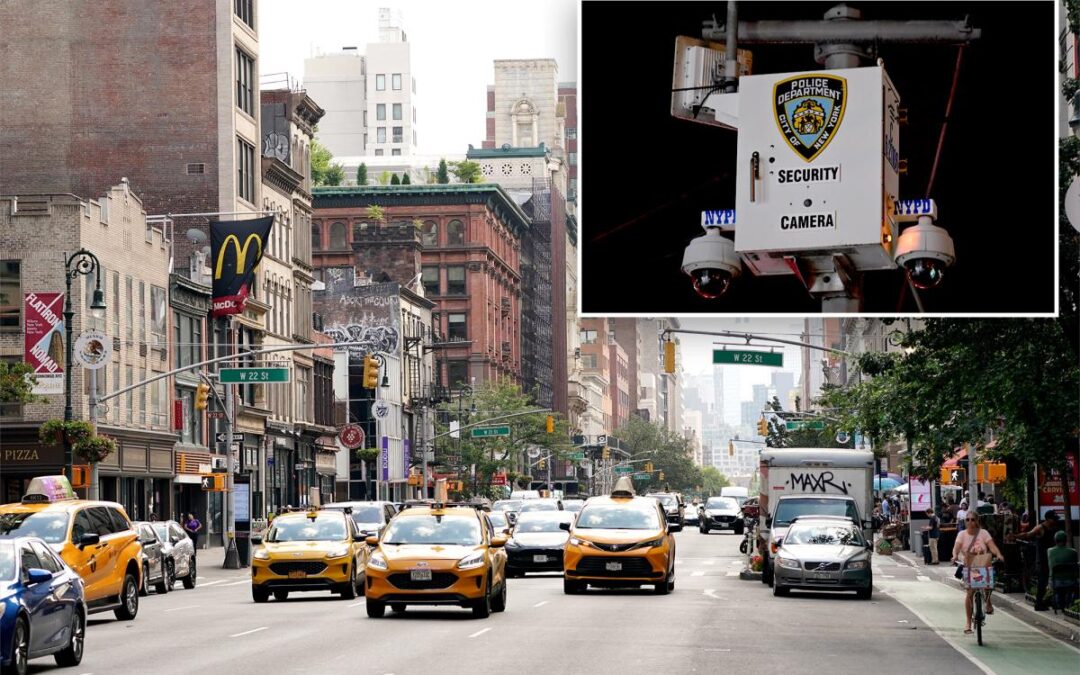
The city has unveiled plans to expand its network of anti-noise cameras from just 11 city-wide, to five in each borough, Gothamist reported.
Situated on poles around the Big Apple, these concealed devices — the locations of which are kept secret — use microphones, fisheye (panoramic) lenses, and license‑plate readers to bust offenders.
Should a car or motorcycle’s sound output eclipse 85 decibels, the camera films the vehicle and snaps its license plate, whereupon the evidence is reviewed by the NYC Department of Environmental Protection.
Those busted with illegally modified mufflers or limit-exceeding exhaust are subject to hefty fines, ranging from $800 to as much as $2,500 for repeat offenders.
Earlier this winter, New York City councilmember Erik Bottcher floated a plan to improve these security cams’ sound recording ability with AI.
Meanwhile, beginning on April 21, 2026, the New York City DEP will require construction sites that perform after‑hours work to install 24/7 continuous noise monitoring devices.
This initiative will mainly apply to sites measuring over 200,000 square feet that are situated within 50 feet of housing, and whose projects run for more than 30 days.
At the personal level, New Yorkers have been encouraged to use the DEP’s “NYC Noise” app to bust loud sound sources that the aforementioned measures don’t catch.
This state-of-the-art soundwave detector allows users to record decibel levels — as well as document the date, location, and source of said noise — before reporting it to the department.
Noise designations include alarms, construction work, dog/animal noise, HVAC/fan noise, loud music, sirens, traffic (cars, buses), or horns.

