
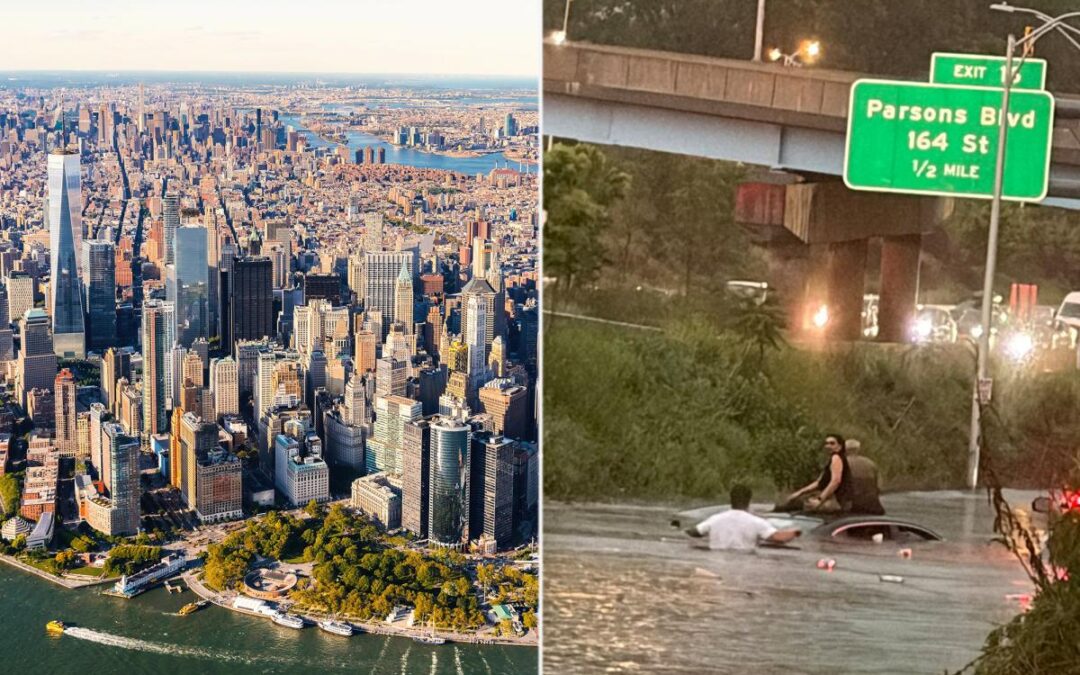
New York is America’s biggest hurricane bullseye — and last night’s floods prove it.
The images were jarring: commuters clinging to the roofs of their submerged cars on the Jackie Robinson Parkway, subway lines grinding to a halt, and floodwaters swallowing the Grand Central Parkway as 60-mph winds tore through the five boroughs Wednesday night. Queens bore the worst of it, with Bellerose recording 2.57 inches of rain in what one local called flooding that arrived within “a span of 25 minutes.”
The chaos arrived as property data firm Cotality released its 2026 Hurricane Risk Report — and its central finding could not be more relevant to what unfolded on the streets of Queens.
Metropolitan New York, the report concludes, is the single largest hurricane exposure zone in the United States, surpassing Miami, Houston, and every Gulf Coast market combined.
More than 3.27 million homes in the New York metro area face moderate or greater hurricane wind risk, carrying a reconstruction cost value of nearly $1.93 trillion. The region also leads the nation in storm surge exposure, with over 631,000 homes vulnerable and roughly $329 billion in property value on the line.
“While hurricanes hit the Northeast less frequently than the Gulf Coast, the region’s immense population density and property value mean the stakes are incredibly high,” Maiclaire Bolton-Smith, Vice President of Insurance Market Insights at Cotality said.
“It’s critical that homeowners in the northeast understand that while landfalling hurricanes may not be as frequent as other states, the risk is still real. A single event can cause historic financial loss, making early mitigation a critical investment that pays significant dividends when a storm inevitably makes landfall.”
Wednesday’s flooding was not a hurricane. But it was a preview.
Charlton D’Souza, a Queens Village native and founder of the nonprofit Passengers United, filmed the scene from inside a bus as the storm raged around him.
“Some of the worst flooding I have seen,” he told The Post.
The I-495 in Fresh Meadows, the Cross-Island Expressway in Bellerose, and the Grand Central Parkway’s eastbound lanes were all shut down. Police sealed off an underpass near 78th Street after two vehicles were trapped under several feet of standing water. A transporter along the New Jersey coastline exploded, knocking down power lines. Temperatures at Newark plunged 19 degrees in 35 minutes.
Scenes out of Hillside, Jamaica, and Staten Island looked, by multiple accounts, biblical.
Nationally, the Cotality report paints a picture that extends well beyond the New York region. Over $12.26 trillion in residential reconstruction value sits at moderate or greater hurricane wind risk across 32.2 million homes in 20 tracked states. Storm surge alone threatens more than 6 million homes and $2.1 trillion in property value.
At the state level, Florida remains the undisputed capital of hurricane exposure with 8.25 million homes at wind risk and $2.56 trillion in reconstruction value — and 2.47 million homes vulnerable to storm surge, a figure more than triple that of Louisiana, the second-ranked state. Texas follows Florida for wind exposure with nearly 4.8 million homes at risk, and North Carolina slots in third with over 3.1 million.
But the report’s most alarming finding is what it calls the hidden flood gap. More than 927,000 homes nationwide, representing $405 billion in property value, carry high hurricane-related flood risk despite sitting outside the federal flood zones that trigger mandatory insurance requirements. Those properties generate an estimated $1.73 billion in annual losses — losses that often blindside homeowners who believed they were safe.
The five most exposed counties for this hidden risk are Orleans Parish, La. ($41.8 billion in unprotected value), Jefferson Parish, La. ($28.6 billion), Brevard County, Fla. ($18.2 billion), Harris County, Texas ($13.3 billion), and Suffolk County, N.Y. ($10.6 billion).
The report also flags the financial consequences of slow post-storm response. A seven-day delay in beginning mitigation efforts after a named storm raises the total repair bill by at least 53% and potentially more than doubles it. Wait three weeks, and costs can balloon by 155% to 290% — driven by mold, structural rot, and contractor demand surges that compound daily.


