
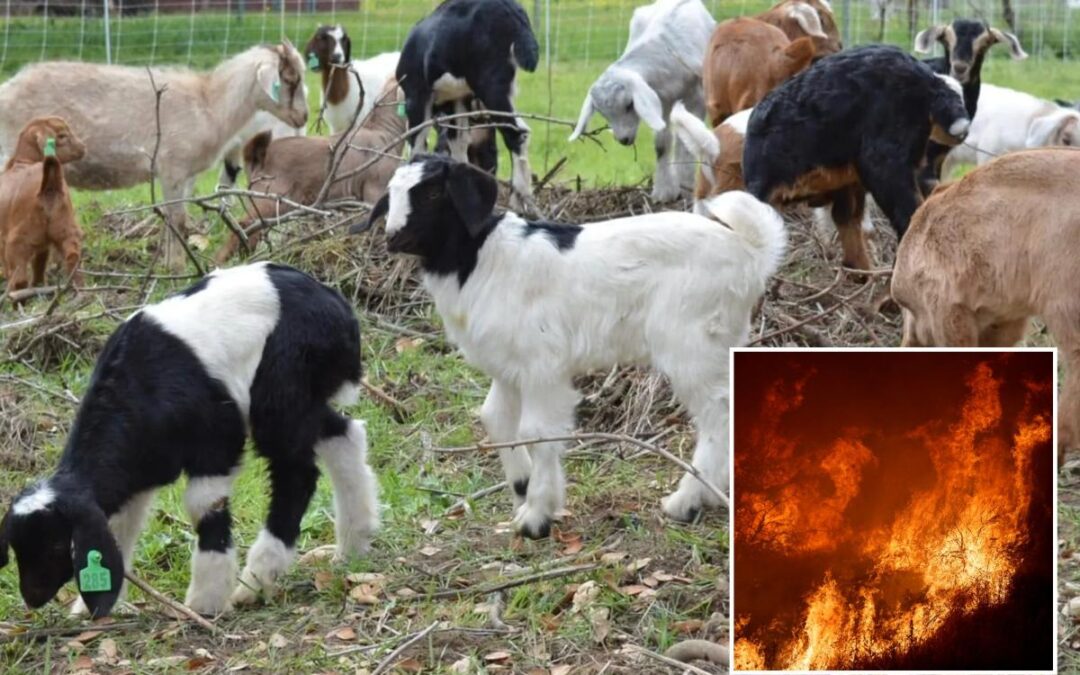
Owners of brush-eating goats enlisted to help prevent California wildfires say a new statewide wage law will put them out of business.
At least 20% of the state’s 500,000 sheep and 125,000 goats are used for targeted grazing, with the animals consume grass and other vegetation to reduce wildfire risk, according to a March report from the California Department of Industrial Relations.
But the cost of employing herders for goats became significantly more expensive this month — up to $240,000 a year — due to a minimum wage exception that expired July 1.
“We will effectively sell these goats to slaughter, and we will go out of business and probably file bankruptcy on this business and be done with it in the state of California,” Western Grazers owner Tim Arrowsmith told KRCR.
Goat herders are often on-duty 24 hours a day since they’re required to live on-site near their herds and be on-call in case of any emergency such as illness or predators.
Herders have been exempt from California’s overtime laws, but in 2016 California lawmakers enacted a measure that led the Department of Industrial Relations to set an alternative minimum monthly wage for such employees. As of 2025, that was $2,934 a month in regular wages and $1,887 in overtime wages, or $4,820 a month.
However, the statute only applied to sheep herders, meaning goat herders would have to be paid the $20,000 per month minimum wage. In the 2023 budget, lawmakers responded by letting goat herders be paid the alternative wage until July of this year.
Now that it’s expired, ranchers are facing what they see as an existential crisis unless lawmakers act again soon.
“We really provide a needed service, and it benefits all of California,” Green Goat Landscapers co-owner Brian Allen told ABC7. “Goats go where people and machines can’t go, and that really reduces that risk of wildfire.”
Higher wages from the 2016 law have already forced ranchers to adjust by assigning more animals to each herder, according to a study in California Agriculture,
An attempt last year in the state legislature to solve the wage issue by permanently exempting goat herders from the agricultural overtime law failed amid opposition from powerful labor groups.
“Herders and all agricultural workers are essential workers, and the least we can do is uphold their right to fair pay; pay that all essential workers deserve,” the California Labor Federation said.
Download The California Post App, follow us on social, and subscribe to our newsletters
California Post News: Facebook, Instagram, TikTok, X, YouTube, WhatsApp, LinkedIn
California Post Sports Facebook, Instagram, TikTok, YouTube, X
California Post Opinion
California Post Newsletters: Sign up here!
California Post App: Download here!
Home delivery: Sign up here!
Page Six Hollywood: Sign up here!
It remains unclear whether the legislature will act as worker advocates push for more herder protections.
The California Post reached out to state Sen. Melissa Hurtado, who is behind the permanent exemption legislation, to see if she would try again. Another lawmaker told KRCR her staff was looking into the issue.
The March report suggested a potential solution of a reduction in monthly wages along with new rules to enhance enforcement of worker protections. It also said the industry could turn to drones to monitor herds remotely.
Allen said his business faces uncertainty in the meantime.
“We haven’t got there yet. I don’t want to get there. We’re hoping that, like I said, that this issue will be taken up,” he said.


