
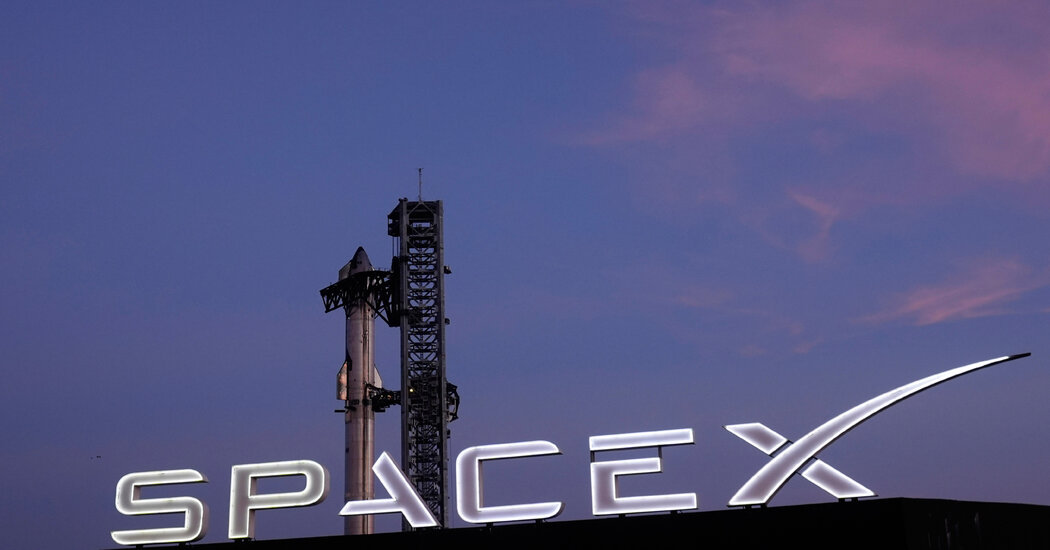
Three of the world’s biggest tech and artificial intelligence companies — SpaceX, OpenAI and Anthropic — may go public this year, all in blockbuster fashion. Leading out of the gate is SpaceX, the rocket and satellite company led by Elon Musk. The company’s offering on Friday will move markets and could make the world’s richest man into the first trillionaire.
Mike Isaac, who reports on tech companies for The Times, and Ryan Mac, who has covered Musk for years, have been reviewing the financials. They joined their editor, Pui-Wing Tam, ahead of Friday’s opening bell to talk with me about what goes into covering both an initial public offering and a mercurial billionaire with baggage.
We also discussed how they make sense of staggering valuations and cut through the big promises in an effort to explain it all to the average investor. This interview has been edited and condensed.
SpaceX is gearing up for the world’s largest initial public offering. What’s the most intriguing thing about this I.P.O. — and the Elon Musk of it all — that people may not know?
MIKE ISAAC: A lot of folks are (rightly) wowed by the astronomical valuations Musk’s bankers are proposing, which reach into the trillions. I’m more fascinated with the products he claims SpaceX will build to get them there.
They feel plucked straight out of a Philip K. Dick novel: Asteroid mining. Unlimited energy to power data centers. And those data centers, mind you, will not be situated on the ground, but rather in low-earth orbit. And last but not least, fashioning himself the first hotelier in charge of your vacations on the moon.
All of that is built into forward-looking revenue projections for this company. This feels irrationally exuberant even for Musk, who is practically defined by rattling off things that feel ridiculous to even consider.
This seems like an especially big year for I.P.O.s. How do you decide which ones to cover, and why?
PUI-WING TAM: We cover the I.P.O.s of the companies that are the biggest in size and likely to have the most impact. SpaceX, Anthropic and OpenAI are all effectively household names now that fit that bill.
MIKE: Far fewer companies go public compared to 30 or so years ago. That is, in part, because companies can stay private longer; it’s easy for them to raise money. But even as the market picks back up, we tend to pay the most attention to the so-called megacap companies — those with the biggest valuation based on the number of shares available.
RYAN MAC: This offering is a milestone for Musk and SpaceX to raise a staggering amount of money. There is added excitement, and perhaps nervousness, as the market is also waiting to see what happens with SpaceX, as Anthropic and OpenAI are also weighing the possibility of going public this year. If that happens, we could see three companies at or near trillion-dollar valuations go public in quick succession. That’s unheard of.
SpaceX set a price of $135 a share, which would value it at $1.77 trillion. It’s hard to wrap your mind around such a figure. How do they come up with that price?
RYAN: A company has an idea of the amount of money it wants to raise and consults with bankers. The bankers go out and meet with potential investors and gauge interest in the stock. Eventually they set a price range for the shares a few days before the I.P.O., and then they settle on a price and sell their shares.
There’s something of an art on pricing an I.P.O. Companies want to raise as much money as possible while also experiencing a “pop,” or increase in share value, on its first day of trading on the public market.
Musk and SpaceX, however, seem to be taking shortcuts. The company has decided to ignore issuing a price range for its I.P.O. shares, instead saying it expects to sell at $135 a share, take it or leave it. It’s one of the many examples of why this isn’t your typical public offering.
So it seems like I.P.O.s reward the creators of companies, bankers and select investors. Is there anything for the average investor or worker with a 401(k)?
MIKE: Something people need to reckon with is how different companies going public today are from ones that went public 30 years ago. The valuations have grown enormous because private investors have piled so much money into companies before their I.P.O.s. That can mean that so much of the upside of growth may already be taken off the table and will go to the private investors before everyday investors will ever see a dime.
It’s also the reason you’re seeing Musk and his bankers tout these high trillion-dollars figures for what is called the total addressable market, or TAM. Retail investors need to believe that the stock will grow if they are considering buying it, and Musk needs to convince them that we’re in early innings. But the company’s filings show it is losing money and spending a lot.
RYAN: If you believe in Musk’s vision, then you may think that the $1.77 trillion valuation is a great deal because eventually SpaceX will control orbital A.I. data centers, factories on the moon and a human colony on Mars. But Musk has a history of making promises and falling short.
How do separate the hype from concrete data?
RYAN: Much of what Musk says he or his companies will do simply does not come to fruition. Our colleagues recently tracked some of his promises over the years and how they’ve panned out. On the other hand, some achievements — Tesla’s mainstreaming of electric vehicles, or SpaceX’s development of semi-reusable rockets — have developed or shifted industries.
Take Starlink, SpaceX’s satellite internet service. Before Starlink, similar services existed but were spotty and expensive. SpaceX has developed a successful business around Starlink and now, based on the numbers, it’s the main revenue engine of the company.
Investors aren’t necessarily investing in the current business performance, but rather Musk’s promises of what the company will do. And that’s why the I.P.O. and the stock’s future performance is incredibly hard to predict.
After its I.P.O., Musk will have to answer to his public shareholders who can sell their stock if they become unhappy with the company’s direction.Those shareholders may become unhappy if SpaceX isn’t able to reach the lofty goals.
Some readers say our coverage is biased against Musk. Musk himself says The Times is unfair to him. The dynamic between reporters and the people they cover can be adversarial — is this one unusually so?
RYAN: I’ve reported on Musk for the better part of a decade now, and I started covering him as his distrust for reporters and media grew. You can’t take it personally. Over the years, I’ve interacted with him a handful of times, and I’ve had the expectation baked in that one of his first instincts will be to undermine or attack our reporting.
He’s the richest man in the world and one of the world’s most powerful people. Typically, these folks don’t appreciate scrutiny. His ownership of X allows him to shape public opinion and boost voices he aligns with — and yes, he temporarily barred me from the platform — but I have not been discouraged from doing my work because he’s posted something about my reporting or The Times.
Switching gears: What are the biggest differences between covering a private versus a public company?
PUI-WING: Disclosure! Public companies report their performance every quarter to shareholders, so there is more transparency. Private companies are not under any obligation to provide information, so they are opaque — which has suited Musk, who has complained about public disclosures in the past.
MIKE: There are few things my reporter brain enjoys more than when a company finally goes public because of the sheer amount of information it is legally required to release.
That said, there are ways that even public companies can obscure their situations, legally, even while providing the required disclosures. Lawyers and finance directors, it turns out, are good at playing word games. It’s our job to comb through the filings and try to decipher those word games.
RYAN: Joining the chorus here. SpaceX has been private for more than two decades and has been quite opaque with its financial performance. What’s interesting, though, is that Musk has said over the years that he despises some of the baggage that comes with running a public company. In 2018, he famously tried to take Tesla, his electric car market, private because he was feeling the pressure that came from public-investor scrutiny. Tesla, however, remained public and experienced a stock boom.
How do we assess a company’s health when the valuation can be in the stratosphere?
MIKE: To me it’s simple: Look at the fundamentals, the books, the numbers.
This is why I am highly skeptical of the exuberance surrounding this entire process for SpaceX. There are one or two good businesses here; Starlink recorded $4.4 billion in revenue last year, for instance. But earlier this year, Musk grafted on xAI, his artificial intelligence lab, which is losing money at an astonishing rate. And the entire premise of SpaceX’s shares climbing eventually is based on the idea that this cash-burning business will one day be enormously profitable. That’s wishful thinking to me, not an investment thesis based on what’s in front of us in the prospectus.
This is why an I.P.O. is so important: Instead of having to trust Musk’s word, we can look at the business. And the business I’m looking at isn’t unilaterally incredible, nor is it a complete dog. We can get a sober view through these disclosures.
What kinds of documents do we review?
PUI-WING: The main document is known as an investment prospectus, which has the jargon-y moniker of S-1. It typically includes the company’s mission statement and a letter to prospective shareholders, as well as revealing revenue, profit or loss, who the biggest holders of its stock are, and other information. That helps us assess a company’s financial health.
The Times has investment rules for journalists involved in business coverage. Pui-Wing, why does that matter?
PUI-WING: We never want to buy and sell stocks of the companies we cover. That could skew motivations by putting us in a position where we could make money from what we are writing about. To preserve fairness and accuracy, we approach coverage without those monetary ties.
As you’ve reported, Mike, the potential I.P.O.s of SpaceX, OpenAI and Anthropic “could create a tsunami of investment and employee wealth” and a whole new kind of market. As the ramifications ricochet through Wall Street and beyond, what will all of you be watching?
MIKE: The flood of new wealth will change what the Bay Area looks like, from homeownership to night life to the next wave of companies to be formed in the years after. We’ve seen this tape played out before: Google in 2004. Facebook in 2012. Uber and Airbnb in 2019 and 2020. And now, we get to see what happens in a post-SpaceX I.P.O. world.
PUI-WING: Money! And the power and the influence it creates.
RYAN: I’ll continue to focus on Musk. One of the big story lines around the I.P.O. is that it could help turn Musk into the world’s first trillionaire. It’s an incredible milestone that not only illustrates his power, but also the increasing wealth gap around the world. Musk has already used his wealth to buy a whole company and influence the 2024 presidential election, following which, he was worth around $350 billion. Since then, he will have almost tripled his net worth. That wealth will give him a source of power to draw from for years to come.

