
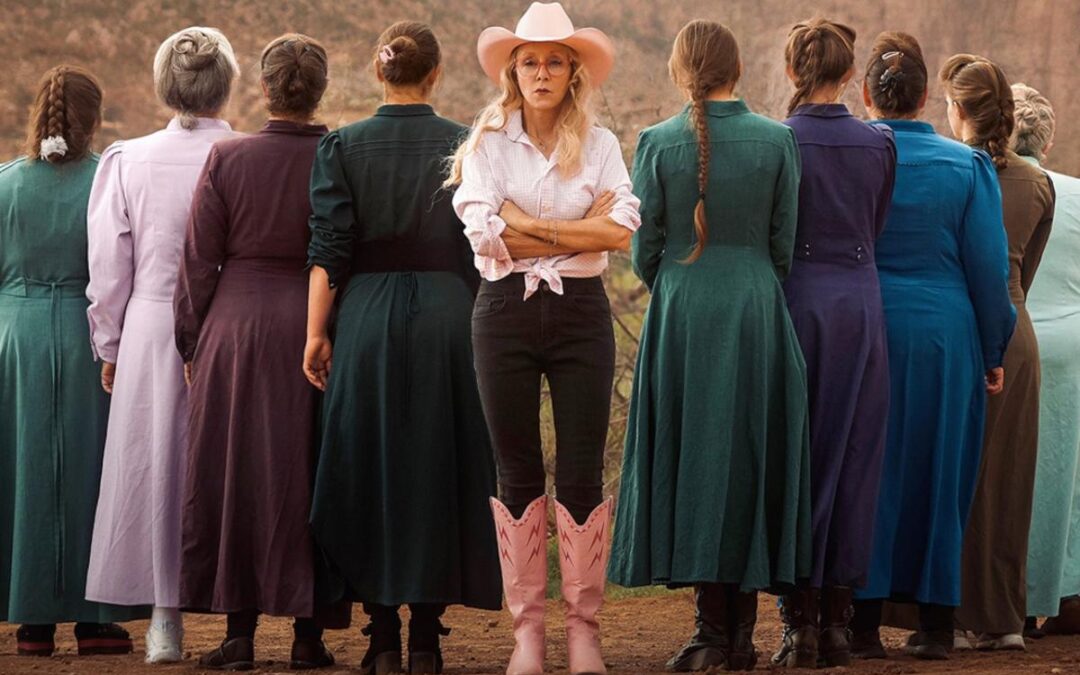
Trust Me: The False Prophet is a four-part docuseries, directed by Rachel Dretzin, that features cult expert Christine Marie; with her husband, videographer Tolga Katas, she infiltrated a Fundamentalist Latter-Day Saints (FLDS) community in Short Creek, Utah, to prove that the women in the cult-ish community were being sexually abused.
Opening Shot: A woman in a long pink coat and a cowboy hat walks down a road, then is directed by her husband to turn to the camera.
The Gist: The FLDS group in Short Creek was led by Warren Jeffs, who was considered a prophet. He kept giving commands to the group even after going to prison, but after some years a man named Samuel Bateman created a splinter group and took on many wives, some of whom were underage.
Dretzin uses Christine Marie and Tolga Katas’ extensive footage, along with interviews with both of them, to tell the story. She also interviews members of the FLDS community from Short Creek that wasn’t part of Bateman’s offshoot, as well as journalists, law enforcement and former members of the Short Creek FLDS community.
Marie, who has had a varied career and life — beauty pageant contestant, ventriloquist, local TV star, escape artist, and more — also has insight into the FLDS community in two ways. She grew up Mormon, in the mainstream LDS, but she also fell under the spell of someone who claimed he was “the prophet,” just like the FLDS community that Warren Jeffs and his father led did. With Jeffs in prison, though, she sensed that the women in the community needed her help, which is why she and her husband moved to Short Creek and decided to film the goings on under the guise of making a documentary.
As the state of Utah took over the town and started evicting FLDS members, Bateman emerged. He had no status in the community, but a few years after a divorce, he had a new younger wife, despite Jeffs declaring from prison that the community cannot start new marriages or have more children while he was incarcerated. Soon, his coterie consisted of enough women and children to fill a flatbed landscaping trailer. The problem was, some of those “wives” Bateman acquired were underage, and Marie needed to find proof that Bateman was sexually abusing them.

What Shows Will It Remind You Of? Trust Me: The False Prophet almost feels like the Jeffs-centric docuseries Keep Sweet: Pray And Obey. Both docuseries were directed by Dretzin.
Our Take: The fact that Dretzin directed the docuseries about Jeffs, and now is directing one about Bateman, just shows how easy it is for a person in a religious cult like FLDS can just declare themselves a “prophet” who, in the case of Bateman, speaks on behalf of Jeffs, and somehow get people to give him money and hand over their wives and daughters. But through Dretzin’s direction, as well as the perspective of Christine Marie, we do get a more sympathetic picture of why this happens, as well as lots of empathy for the victims of people like Bateman.
In a way, Trust Me: The False Prophet is as much a portrait of Christine Marie as it is about the Bateman-led FLDS offshoot. At first it seems that Marie’s desire to help the women in the FLDS community in Short Creek is a bit delusional; how could one outsider parachute into such a closed-off community and help? But the more we find out about Marie and the more we hear from her, the more we realize that if anyone can do it, it’s her.
After all, she not only has personal cult experience, but she has studied the psychology of cults and earned a PhD specializing in the topic. Both she and her husband seem to have an incredible ability to “go undercover” and ingratiating themselves to scum like Bateman despite what they know about him, becoming friendly enough that he asks them to film him almost all day, every day. He also ends up leaving them alone with his “wives” and they start to open up to them. That is no small feat, given the fact that they were viewed with distrust when they came to town in 2016.
Because of her history and her studies, Marie doesn’t see FLDS women — and even some of the men — as anything other than people who will go far to confirm their faith and desperate for someone of strong faith to lead them. It’s why, when Bateman stepped into the vacuum left by Jeffs, three men of status in the community decided to follow him, fund him and provide him with their wives and daughters. It’s a fascinating study of human nature, and not from the usual “how could these people fall for this crap?” standpoint we tend to see from cult documentaries.

Performance Worth Watching: Christine Marie is definitely a character, and while she seems a bit off-kilter on first glance, the more we see of her the more we like.
Sex And Skin: There’s talk by Bateman of “giving” some of his wives to his benefactors, one of which is underage. It’s in a voice recording secretly taped by Marie.
Parting Shot: Marie and Katas try to figure out what to do after she gets the shocking recording of Bateman talking about “giving” his wives to community members.
Sleeper Star: We were surprised at how pragmatic the women currently in the FLDS community that wasn’t the Bateman offshoot were. They knew something was amiss with Bateman and the women who were with him, and wanted nothing to do with them.
Most Pilot-y Line: Dretzin put up a graphic explaining that the faces of the minors who were “married” to Bateman would be digitally replaced instead of blurred. It’s weird and uncanny, but we guess it’s better than just seeing blurred faces for the entire run of the series.
Our Call: STREAM IT. Trust Me: The False Prophet isn’t interested in anything else but examining how Christine Marie and Tolga Katas took down Sam Bateman; the docuseries refreshingly doesn’t pass any judgement on the FLDS community, especially the people who followed Bateman.
Joel Keller (@joelkeller) writes about food, entertainment, parenting and tech, but he doesn’t kid himself: he’s a TV junkie. His writing has appeared in the New York Times, Slate, Salon, RollingStone.com, VanityFair.com, Fast Company and elsewhere.


