
“Men don’t usually like being called nice. Not all men, not only men, but they think it’s a sign of weakness. Only I think it’s the opposite. It’s a powerful quality. The world could use a lot more of it.”
Amen, sister. Charlotte Fischer is the beautiful stranger to whom alien-among-us John Sugar has become attracted. Seriously, his mental slideshow of classic movies flips right to Rita Hayworth in Gilda. But I think it’s this statement as much as her looks that wins Sugar’s heart, or whatever he’s got in that blue body of his. That makes it worth unpacking.

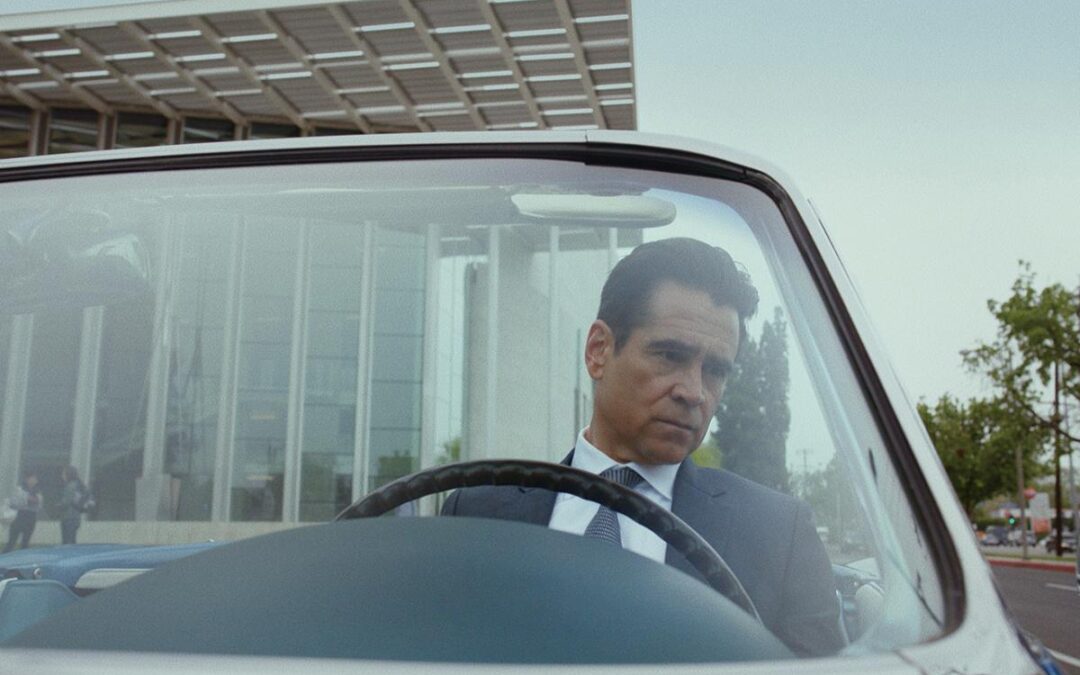
As played by Colin Farrell, John Sugar is indeed a powerful character, and not because he can stir the ice cubes in his drink with his mind either. His niceness doesn’t involve being the life of the party or a big boisterous glad-hander. Sugar is soft-spoken, deliberate. He observes closely and chooses his words carefully. Crucially, when he befriends Blaine (Catfish Jean), a security guard, by recommending Casablanca because its hero has the same name, or when he expresses sincere interest in whether his waiter got the part he’d been called back for, it’s because he bothered to notice them at all. There’s a bit where he’s kind to a nurse getting fired despite being employee of the month. John Sugar sees the working class as people, not equipment. His niceness is just basic human decency.
But as his client Danny angrily points out, John’s instinctive belief that poor people are people doesn’t mean he’s one of them, not when he lives in a hotel, owns a second home in the hills, and has more expensive suits than he can keep track of. Nor does his status as “an immigrant, I guess” mean he can truly understand what the city’s Mexican-American or Korean-American populations go through, or how it feels to be undocumented, not when he presents as a handsome wealthy white guy whose papers have all been forged by alien experts.
This week, John continues his sideline of following the career of former senator Tyson Pavich (John D’Aquino), who’s now a big tech CEO on a hiring spree with science professors. Sugar suspects all this has something to do with how his people were exposed and forced to flee Earth.
He also hires Val, the car thief we met last episode, as his partner, correctly stating that he needs one. It’s not just that it will make him a more effective P.I. — it will make him feel less alone in a world where he is the last of his kind, as far as he knows. (I think it’s safe to doubt that.)
But his main case remains helping up-and-coming boxer Danny Moon locate his missing brother, Ji. With Blaine’s help, Sugar discovers that a mystery man in black with a baseball cap to match was following him the last time he was seen.
Sugar, however, is not the only one looking for Ji. A gang called EZ4 is serious enough about catching and killing him that they’re executing random civilians who happen to match his description. With the help of medical examiner Tom Flyberg (the great Shea Whigham), Sugar gains access to a slain shooter’s phone and finds a picture of Ji crammed into a closet in the hospital, being used to help the gang’s hitmen identify their quarry.
Sugar concludes that Ji was into something serious. Being Sugar, he simply approaches a member of the gang and essentially asks to speak with his manager, or whoever it was who took that photo.
Instead, rather predictably, the gang turns its ire on Sugar. Faking him out by chasing him in a fast red sports car, the gangsters sneak up the moment he lets his guard down and let him have it from a motorcycle. We leave Sugar gazing up at the stars whence he came, his car rolling along as Nat “King” Cole sings “Stardust” — a dreamy moment in an episode rich with them.
But the episode’s loveliest shot isn’t one of Sugar’s visions of the cosmos, gorgeous as those are. It’s when he visits the grandmother of a murdered friend of Ji’s, sees that her grief has rendered her unable to do basic tasks like the dishes, and voluntarily starts doing them for her. Unwilling to let a guest in her home do all the work himself, she gets up and helps dry. This goes on for a wordless minute or two — a moving moment of human connection. (Well, half-human, anyway.)

It’s scenes like these — to say nothing of the whole “John Sugar has secretly been an alien all along” thing — that make the weaker material harder to ignore. When Sugar told Val “I see people” as he explained why he wanted to hire her of all people, I saw her response — “So what do you see in me?” — coming from a mile away. Dialogue patterns this predictable stem from genre convention, not from real character work. More pointedly, so far there’s not much more to the season’s depiction of LA’s immigrant community than boxing gyms, face tattoos, grieving abuelitas, and gangbanger drive-bys. The resulting portrait feels both stereotyped and dull.
Now, I in no way believe that some street gang Sugar’s never heard of before are the ultimate bad guys behind Ji’s disappearance and John’s shooting. There’s the man in the black ballcap, and Senator Pavitch, and the mysterious and alluring Charlotte, and whatever other surprises a show that once sprang “he’s from another planet” on us might have in store.
Perhaps most importantly, there’s the show’s subgenre to consider. From Chinatown to The Big Lebowski, Los Angeles neo-noir is defined by its byzantine webs of players, subplots, dead ends, and conspiracies, as snarled and tangled as the city’s freeways. The more you learn, the less you know. That’s not quite Sugar’s style of course, but it’s safe to say that in a story like this nothing’s ever quite what it seems. On this show, that’s more literally true than usual.

Sean T. Collins (@seantcollins.com on Bluesky and theseantcollins on Patreon) has written about television for The New York Times, Vulture, Rolling Stone, and elsewhere. He is the author of Pain Don’t Hurt: Meditations on Road House. He lives with his family on Long Island.

