
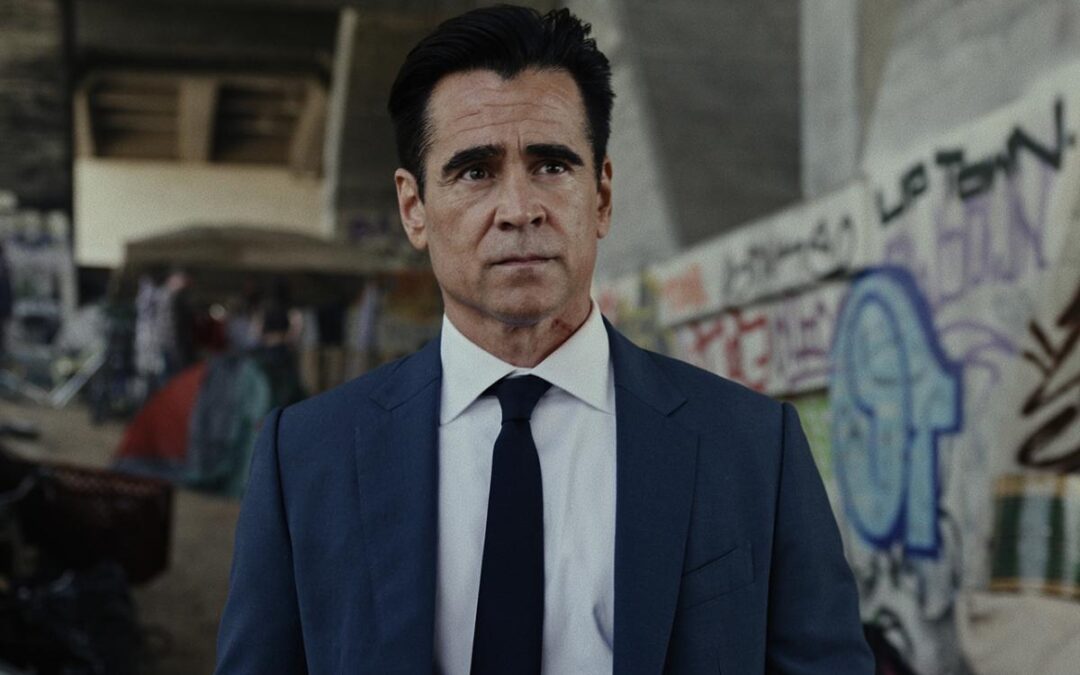
I’m worried about Sugar, man. Not the guy, the show.
Showrunner switches bring growing pains, I get that. Abandoning the entire raison d’être established for the show by its Season 1 finale before the opening credits rolled on the Season 2 premiere was…bold, let’s say, but change is value-neutral in itself. What we got in exchange for losing Jason Butler Harner and the Fugitive-style hunt for justice his character presented us with would go a long way to determining whether this was a change worth making.
So far? Yeah, I’m worried about Sugar, man.

In this episode, Sugar recovers from his drive-by shooting in the previous one by driving his now busted car to his friend Val, then high-tailing it home in a stolen to give himself an infusion of alien blood. (It’s got little sparkly swirly things in it.) The EZ4s are the gang he suspects of involvement in the disappearance of Ji Moon and the death of a kid named Chuy — it’s likely Ji witnessed his execution in the hospital and had to run from his assassin. And they mean business about keeping him out of their business.
Unexpectedly, Ji surfaces. He calls up Danny and arranges a meeting at a nightclub, sporting newly bleached hair for disguise purposes. When he lays eyes on Sugar, he assumes the guy’s a cop and runs for it; a buddy brains John with a wok and Ji makes his escape. Sugar has to work to keep Danny from giving up on his brother entirely, as his demeanor seemed entirely different, and not for the better. Some smooth customer named Len Pankow (Rell Battle) offers Danny a fight against a big star in Vegas, meanwhile, and it’s hard not to assume the two events are related.
With the help of his beardy cop buddy Flyburg, Sugar learns that the boss of the EZ4s goes by the name of José Guapo. (El Guapo. Really.) So he simply strolls into their headquarters and asks to speak to the guy, which favor he’s granted by a low-ranking soldier. The soldier, surprisingly, turns out to be the man himself. (Allegedly.)
Guapo is about to pull the trigger on Sugar when the Sheriff’s Department bursts in, killing José and leading Sugar away in cuffs. He’s instantly released, but in the process he sees a man wearing the same wristwatch as the mystery hospital hitman — a cop, played by Tony Dalton.
Sugar also flirts heavily with Charlotte, the do-gooder from his hotel, in the pool while nightswimming. She’s asking him if, ethically, the ends justify the means. Not a good sign, John! Sugar is attracted to her, but sex with humans is verboten by his people. He’s also got the “ghost” of a woman named Peg (Laura San Giacomo) appearing to him in his mind. Also not a good sign, John!
This episode has a very simple structure. John Sugar goes to a place, talks to a person, and picks up a clue. He files that information away for the next time he goes to place, talks to a person, and picks up a clue — the phrase “Fire Sale in Downertown,” say, or a glimpse of a telltale wristwatch. He does this effortlessly, everywhere from nightclubs to homeless encampments.
As always, almost everyone opens up to him right away, while he quickly recovers from encounters with those who don’t, even if they shoot him and his car full of holes, knock him to the pavement by hitting him in the head with a skillet, or dragging him to a torture and execution chamber. My wife compared it to watching someone play an old CD-ROM mystery-adventure game, where you play as John Sugar, move to new Rooms, meet Suspects, have pro forma dialogue exchanges with them, find Clues that connect you to the next Room and the next Suspect, and so on and so on and so on.
Like such a protagonist, there’s no killing Sugar (though he’ll surely have an even closer call with no available replacement blood before the season’s out). Even the militarized cops who burst in on that situation avoid shooting him, despite the dead bodies Sugar sees everywhere on his way out of the building. I suppose they saw a white guy in a suit and realized he’s not the kind of person they’re in the business of shooting. I can’t tell if a point is being made with this.

I’ve written that Sugar is a fantasy of a frictionless, trafficless Los Angeles, in which our angelic alien glides from destination to destination, easily earning the trust of people from across the town’s tapestry of cultures. It enhances the show’s dreamy tone, sure. But does the fact that John Sugar is, for all intents and purposes, a rich white man in a suit influence his ability to do what he does so effortlessly? The other explanations — highly stylized writing, or as-yet undisclosed alien pheromones — are satisfying, but they don’t make for a particularly rich text.
What has always distinguished Sugar is the off-kilter excellence of its execution. In some senses that’s still there: the photography of Los Angeles, whether at night or in broad daylight, remains absolutely beautiful, and so does the photography of Colin Farrell.
But the wheels are really starting to creak everywhere else. The sequence in which Sugar walks through the EZ4’s base of operations is frankly an embarrassment, a series of glowering tattooed Mexicans with white socks pulled up high glowering at the only white person on the screen. To paraphrase Community, I can excuse racism, but I draw the line at a boring walk through a yard controlled by drug dealers when The Wire did this for season after season without ever once being dull about it twenty damn years ago.
Danny and Ji’s model-immigrant hard work/hard luck story isn’t all that much more interesting. The homeless encampment wouldn’t feel out of place on a CBS procedural. Any club scene on TV has to compete with the likes of Industry, and this one doesn’t cut it.
Even if the real bad guys wind up being cops, as seems likely — a sheriff’s gang, perhaps — we’re hardly blazing new trails here. (Daredevil: Born Again, on which Dalton also stars, had corrupt, violent, militarized cops take over all of New York City!) The narration drills Sugar’s whole humanity: so beautiful in its very imperfections outlook into us ad nauseam. That attitude is belied when the show about him, which sees the world through his eyes, leaves so much potential beauty and imperfection on the table.

Sean T. Collins (@seantcollins.com on Bluesky and theseantcollins on Patreon) has written about television for The New York Times, Vulture, Rolling Stone, and elsewhere. He is the author of Pain Don’t Hurt: Meditations on Road House. He lives with his family on Long Island.

