
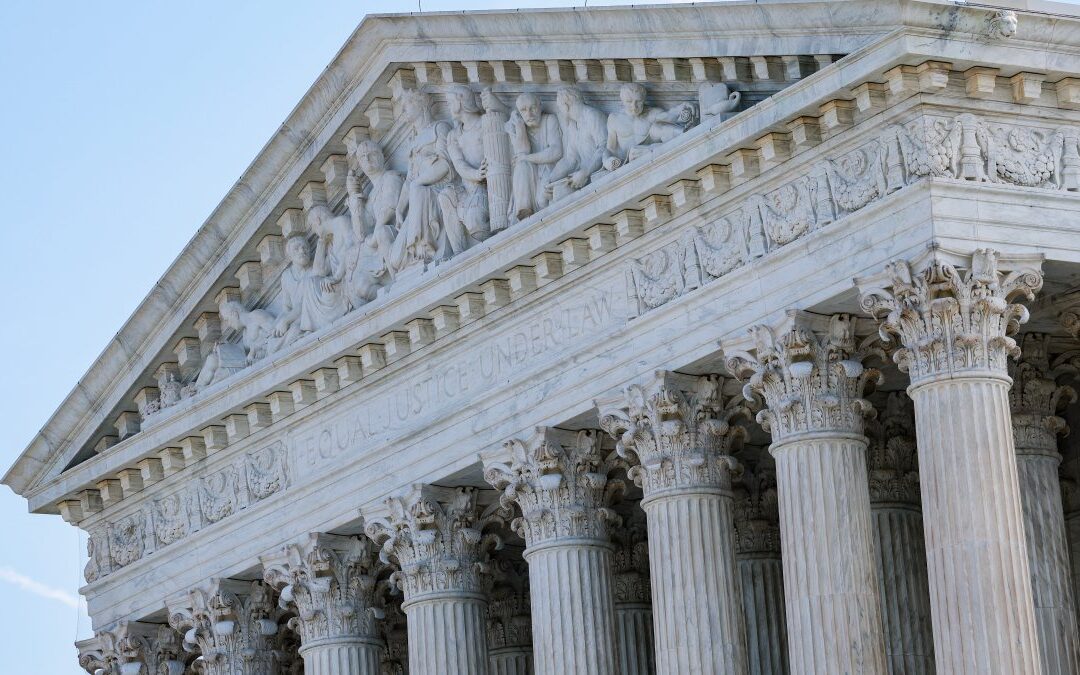
The Supreme Court on Thursday allowed the Trump administration to end legal protections for migrants fleeing violence and natural disaster in Haiti and Syria, exposing hundreds of thousands more people to potential deportation.
In a 6-3 decision, the conservative justices overturned lower court orders and allowed the Department of Homeland Security to swiftly end Temporary Protected Status, a program that protects a total of 1.3 million people from 17 countries. In the opinion by Justice Samuel Alito, the court held that Syrian and Haitian nationals are not “entitled to orders postponing the terminations during litigation” and determined federal judges have no authority to weigh in on many of challengers’ claims.
“The TPS statute plainly bars consideration of respondents’ non-constitutional claims,” Alito wrote for the majority.
Justices Elena Kagan, Sonia Sotomayor and Kentanji Brown Jackson, the court’s three liberal justices, dissented.
“True enough that TPS is a temporary program, and that it did not promise the plaintiffs never-ending humanitarian protection,” Kagan wrote in the dissenting opinion. “But the law prevents the program from ending as it likely did here — without the required consultations about country conditions and, as to Haiti, with impermissible race-based considerations tainting the decision.”
She added that as a result of the decision, “hundreds of thousands of lives will be uprooted” while litigation continues in the lower courts.
The high court also previously sided with the administration and allowed the end of the program for people from Venezuela as lawsuits continue to play out.
TPS was created by Congress in 1990 to prevent deportations to countries suffering from natural disasters, civil strife and other instability. It allows people already in the country to stay with work permits in increments of up to 18 months, but it doesn’t provide a path to citizenship.
The U.S. first granted protections to Haitians in 2010 after a catastrophic earthquake, and extended them multiple times amid ongoing gang violence that has displaced more than a million people, according to court documents.
Syrians, meanwhile, were first granted protected status in 2012, during a civil war that lasted for more than a decade before the fall of President Bashar Assad’s government in late 2024.
Since Trump returned to the White House in January 2025, DHS has ended the protections people from 13 countries. Some who have lived and worked in the U.S. legally for more than a decade have lost jobs and housing in a matter of weeks, lawyers said.
The terminations were made even though countries like Haiti and Syria remain dangerous, immigration attorneys said. Four Haitian women who were deported from the United States in February were found beheaded and dumped in a river several months later, lawyers said in court documents.
Still, the Trump administration argued that judges can’t second-guess immigration officials’ decisions about the protections, which were intended to be temporary.
Lawyers for about 350,000 migrants from Haiti and 6,000 from Syria say the government short-circuited the process and that judges can consider whether authorities followed all the steps laid out in the law.
Immigration attorneys also argued the administration ended the protections in an unlawfully hasty process tinged by racial animus. During his 2024 presidential campaign, Trump amplified false rumors that Haitian immigrants were abducting and eating dogs and cats.
Federal authorities deny that racial animus played a role. They also cited a Supreme Court decision from Trump’s first term that rejected bias claims based on his social media posts and upheld a travel ban on several Muslim-majority countries.
The administration appealed to the high court after judges in New York and the District of Columbia agreed to delay the end of protections. One judge found that “hostility to nonwhite immigrants” likely played a role in the decision to end protections for Haitians.
In her dissenting opinion, Kagan wrote that public comments made by Trump showed that a “racially discriminatory purpose had entered into the TPS termination.” Kagan also took her conservative colleagues to task, writing that the remarks from Trump were so “repellent and racially inflected that the majority declines to put them in print” in their opinion.
“The statements fairly shout, in their racial undertones and overtones alike, that race entered into the president’s resolve to remove Haitians from this country,” she added.


