
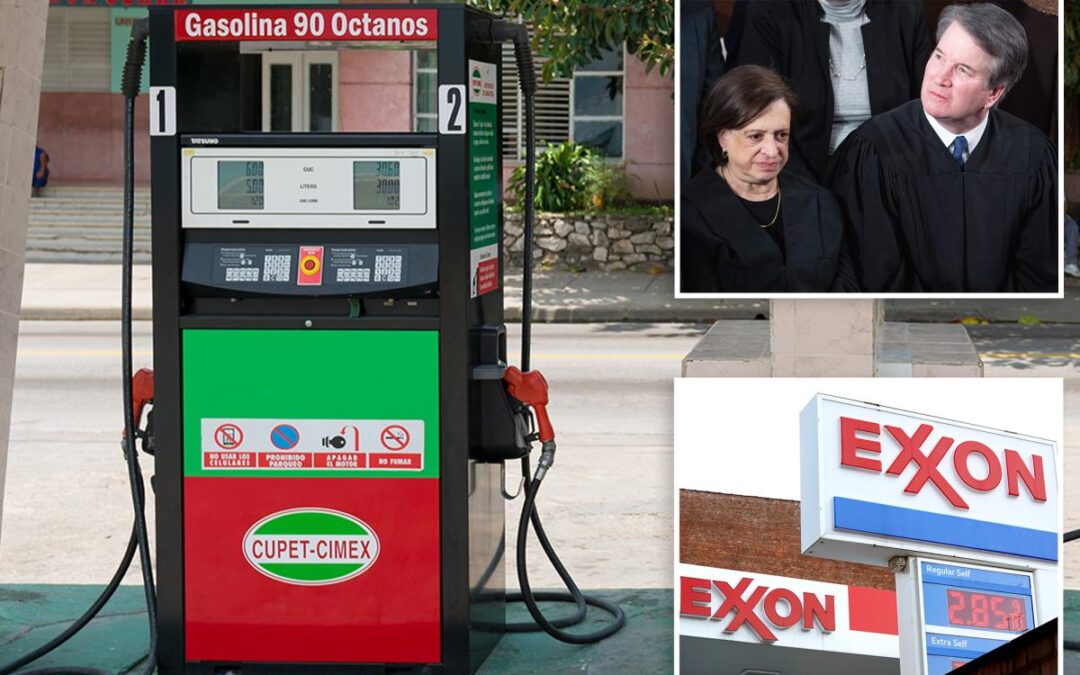
The US Supreme Court made it easier on Tuesday for US companies to seek compensation from Cuba’s government for property seized decades ago by former leader Fidel Castro’s government, ruling in favor of Exxon Mobil in its lawsuit against Cuban state-owned firm Corporación CIMEX.
In a 6-3 decision, the court said a legal defense called foreign sovereign immunity, which generally prohibits US lawsuits against foreign governments and their agents, is not available in cases like the one Exxon brought against CIMEX under a 1996 US law called the Helms-Burton Act.
Conservative Justice Brett Kavanaugh, who authored the ruling, wrote that the 30-year-old federal law eliminates “the sovereign immunity of Cuban agencies and instrumentalities.”
“The Helms-Burton Act authorizes private suits against Cuban agencies and instrumentalities — suits that would largely be nonstarters if subjected to the FSIA’s requirements,” Kavanaugh wrote, referring to the Foreign Sovereign Immunities Act of 1976.
The court’s six conservative justices were in the majority. Justice Elena Kagan wrote a dissent that was joined by the court’s two other liberal members.
Kagan said that the plaintiffs should be required to show that their suit was exempt from the Foreign Sovereign Immunities Act, arguing that, “Nothing in the text or ‘architecture’ of the Helms-Burton Act suggests that Congress abrogated the sovereign immunity of these defendants — much less that it did so with the requisite unmistakable clarity.”
The Supreme Court reversed a lower court’s 2024 ruling that CIMEX could invoke the sovereign immunity defense.
The decision removes a major obstacle Exxon faced in its 2019 lawsuit that accused CIMEX of unlawfully using a refinery and service stations that once belonged to Standard Oil, Exxon’s corporate predecessor. The case will return to a lower court for further deliberations on CIMEX’s potential liability.
A Helms-Burton Act provision called Title III permits lawsuits to be filed in U.S. courts against anyone who “traffics” in property confiscated by Cuba’s communist government after the 1959 revolution that brought Castro to power. The Trump administration supported Exxon’s appeal to the Supreme Court.
The ruling was issued at a rancorous time in US-Cuban relations. The US last month brought murder charges against former Cuban President Raúl Castro, Fidel’s younger brother, in a major escalation in Trump’s pressure campaign against Cuba’s government.
Under Trump, the US has effectively imposed a blockade on Cuba by threatening sanctions on countries supplying it with fuel, triggering power outages and exacerbating its worst crisis in decades.
Exxon’s suit involved Fidel Castro’s confiscation of all of the U.S. energy company’s Cuban oil and gas assets in 1959, which represented a loss valued at $70 million at the time. Exxon’s current claim is now valued at more than $1 billion because of interest and the potential for enhanced damages.
According to Exxon, its assets were transferred to CIMEX, Cuba’s largest state-owned conglomerate. CIMEX continues to hold and profit from the confiscated property.
Exxon’s lawsuit was part of a flood of about 40 cases filed under the Helms-Burton Act in 2019 and 2020 because of a change in U.S. policy toward Cuba during Trump’s first term in office.
When it passed the Helms-Burton Act, Congress authorized the U.S. president to suspend Title III on national security grounds. The provision was then suspended by three presidents seeking to avoid diplomatic conflicts with allies like Canada and Spain whose companies have invested in Cuba. Trump lifted that suspension in 2019.
Lower court rulings had made it difficult for US companies to prevail in such cases, with most lawsuits being dismissed on jurisdictional or procedural grounds.

