
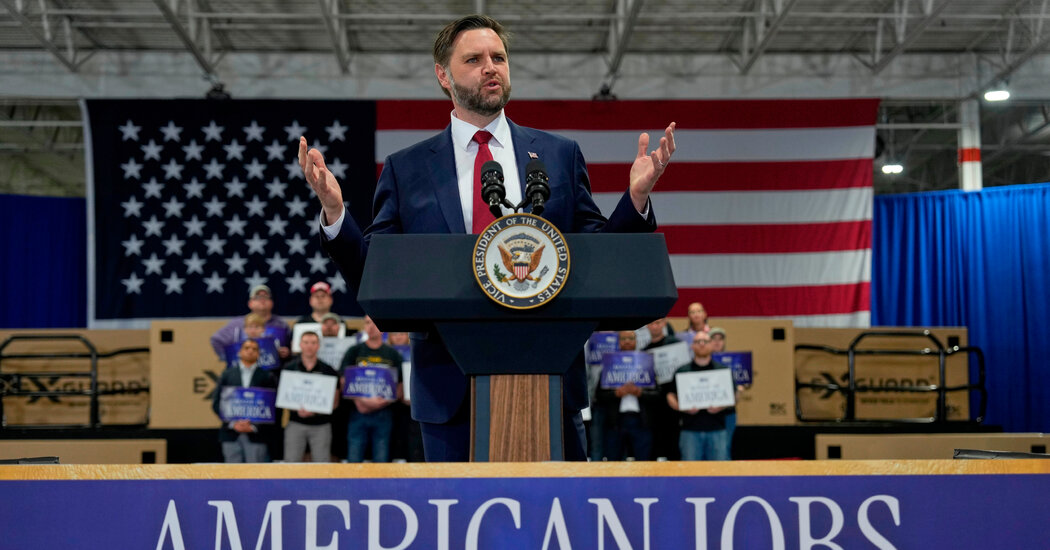
Vice President JD Vance cast Democrats as out of the mainstream and defended the Trump administration’s economic record as he campaigned on Tuesday for an endangered House Republican in Iowa, a state that is critical for Republicans in the midterms.
The trip, which began with a party fund-raiser in Oklahoma, offered something of a blueprint for the vice president as the midterm cycle ramps up: raising money and boosting vulnerable incumbents who are facing the political headwinds of higher gas prices, a president with sagging approval ratings and an unpopular war in Iran.
The visit to Iowa held additional significance, because the state will kick off the presidential nominating calendar for Republicans in less than two years, when Mr. Vance is widely expected to run to succeed President Trump.
It was not an easy environment in which to rally voters. In his speech on Tuesday, Mr. Vance acknowledged the effects of rising energy prices on the agricultural industry in the state, calling the ongoing conflict in Iran “a little blip” that the administration needs to get past.
“We also know that a lot of our farmers are struggling with high fertilizer prices,” Mr. Vance said. “I’m aware of that. As the president of the United States has said, we got a little — a little blip in the Middle East. We’ve got to take care of some business on the foreign policy side.”
The setting, a manufacturing plant in Des Moines, was tailor-made to address the economic concerns of voters, with supporters waving campaign-style “Made in America” posters and Mr. Vance speaking on a platform emblazoned with the words “American Jobs.”
The event was held mostly to boost Representative Zach Nunn, an ally of the administration who is locked in what is expected to be one of the country’s most competitive House races. Mr. Vance praised the congressman and called out Mr. Nunn’s opponent by name — Sarah Trone Garriott — though not before shuffling his notes and asking Mr. Nunn from the stage for an assist in identifying her.
Just as Mr. Trump did in 2024, Mr. Vance leaned heavily on accusing Democrats of supporting undocumented immigrants.
“My friends, this is not a normal election. This is not a normal political environment,” he said, accusing Democrats of wanting “to take all of your money and give it to illegal aliens.”
Iowa has trended away from the Democratic Party for much of the Trump era, but the state is at the epicenter of the 2026 midterm fight. It is home to three potentially competitive House races, an open U.S. Senate contest and a governor’s race that might even favor the Democrats.
“Iowa is going to be the hottest state in the country,” said Bob Vander Plaats, a prominent evangelical conservative leader in the state.
Already, the leading Senate Republican super PAC has announced plans to spend $29 million defending the Senate seat this fall, a sign of its expected competitiveness. And super PACs aligned with House Republicans and House Democrats say they will spend nearly $22 million on ad reservations for the fall congressional campaigns. That is more than five times as much as initial reservations in 2024 ($1.4 million for Democrats then; $2.7 million for Republicans.)
Republicans are facing economic challenges. The state’s agricultural industry has been buffeted by Mr. Trump’s tariff policies and, more recently, by spiking gas prices caused by the war in Iran. The price at the pump in Des Moines this week was around $4 per gallon — a full dollar more than a year ago.
Mr. Vance sought to acknowledge that Americans were still unsatisfied with the conditions of the economy, but he cast blame on Democrats for what the Trump administration had inherited.
”On the one hand, we got a great record to brag on,” Mr. Vance said. “On the other hand, because of the hole that the Biden administration, the Democrats, put us in, we got a lot more work to do.”
In Iowa, the Democratic nominee for governor and state auditor, Rob Sand, has made bipartisan appeals a hallmark of his political career and has amassed a sizable war chest, while Republicans are fighting through a messy, three-way primary ahead of June.
Republican officials in the state have quietly expressed concerns about the strength and competitiveness of the campaign of the early Republican front-runner, Representative Randy Feenstra, who faces multiple challengers in the state’s primaries on June 2. The two leading rivals are Adam Steen, a former state official who is backed by Mr. Vander Plaats’s organization and Zach Lahns, a businessman who is self-funding his candidacy.
“It’s still solid Republican,” Mr. Feenstra said in a brief interview at Mr. Vance’s event, dismissing Democratic chances in the state.
Yet at the Vance event, concerns were palpable that Mr. Sand represented a real threat in the governor’s race. One Republican said he was the only Democrat he heard on conservative talk radio. Another said Mr. Sand was doing a good job as auditor, even as he opposed him for governor.
In the Senate race to replace Joni Ernst, who is retiring, Republicans have rallied behind Representative Ashley Hinson. Democrats face a primary next month between two state legislators, State Representative Josh Turek and State Senator Zach Wahls. Mr. Turek and Mr. Wahls held their first debate on Tuesday evening.
“You’ve got this once-in-a-generation opportunity where you’ve got no power of incumbency,” Mr. Turek said in an interview about the open races for both governor and Senate.
In 2026, few states are as important as Iowa to the Republican Party’s slim chances of holding power in the House.
Mr. Nunn is trying to hold a seat that Mr. Trump won by less than half a percentage point in 2020. The expansive district includes the capital city of Des Moines and the fast-growing suburbs of Dallas County, while stretching south toward the Missouri border and taking in much of the southwest quadrant of the state.
Mr. Nunn’s challenger, Ms. Trone Garriott, a state senator and an ordained minister, is one of 20 challengers in the Democratic Party’s “red to blue” program, meaning she is likely to benefit from national donors focused on flipping the House.
The other highly competitive seat is held by Representative Mariannette Miller-Meeks, who has won two of the narrowest re-election bids in the nation in recent years, including a six-vote victory in 2020. She is expected to face Christina Bohannan, a Democrat who lost by fewer than 1,000 votes in 2024, in a rematch this fall.
There is also the open seat to replace Ms. Hinson in Iowa’s Second Congressional District, which stretches across the state’s northeastern quadrant.
In the Democratic Senate primary, a national veterans group, VoteVets, has spent more than $5 million trying to promote Mr. Turek, who was a Paralympic gold medalist on the U.S. men’s wheelchair basketball team. Mr. Turek was born with spina bifida after his father was exposed to Agent Orange in Vietnam.
Mr. Wahls has accused national groups of meddling and made his opposition to Senator Chuck Schumer of New York, the Democratic leader, an issue in the race, which he frames as “Iowans over insiders.”


