
Standing at the north end of Bowling Green in Lower Manhattan, tourists’ eyes are focused on a chunky slab of horned, snorting bronze on four hooves. The Charging Bull. Visitors from the around world wait — not always patiently — for their turn to capture the 7,100‑ pound sculpture’s best angles: namely, the view from behind, where the animal’s masculine attributes are on full display, offering undeniable visual confirmation that this is, indeed, a bull and not a cow.
But few tourists (or New Yorkers, for that matter) take note of the small park nearby, the oldest public park in New York City. Yet Bowling Green, like many other sites in Manhattan, saw key events that forever shaped the early days of the United States and truly capture the spirit of the American Revolution.
More than 250 years ago, this part of the island known as “Manahatta” to its original inhabitants, the Lenape, was humming with industry. New York served as a key port of trade and commerce before and during the Colonial era. When John Adams came through in 1774, he wrote in his diary of the “Opulence and Splendor” of the city and, later in that same paragraph, added that New Yorkers “talk very loud, very fast, and altogether. If they ask you a Question, before you can utter 3 Words of your Answer, they will break out upon you, again — and talk away.”
In the spring and summer of 1776, Manhattan served as the headquarters of the newly established Continental Army and was buzzing with news of the impending arrival of British ships. Hundreds of vessels and tens of thousands of British soldiers were ready to pounce on the strategic gem that was Manhattan. The devastating Battle of Brooklyn on August 27, 1776 — the largest battle of the Revolutionary War — was followed by the British landing at Kip’s Bay on September 15. The British made themselves right at home in New York for seven years, until the end of the war.
While thoughts of walking in the steps of American Colonial history often bring to mind places like Boston, Philadelphia or Colonial Williamsburg, Revolutionary history remains ever present in downtown Manhattan, too.
City Hall Park
Broadway & Chambers Street
Outside of the war itself, the big news in the summer of 1776 was a Declaration of Independence from Britain. How individuals learned what, exactly, was being declared was via newspapers, broadsides and public readings — like the one George Washington ordered for troops on July 9, 1776.
Orders of the day stated: “The several brigades are to be drawn up this evening on their respective Parades, at six OClock, when the declaration of Congress, shewing the grounds & reasons of this measure, is to be read with an audible voice.”
And so it happened. Continental troops and civilians gathered in what was then known as the Commons in Lower Manhattan, the vicinity of the park in front of New York City’s present‑day City Hall, to hear the document declaring the colonies’ split from England.
According to Washington’s aide‑de‑camp, Lieutenant Colonel Samuel Blachley Webb, the reading itself was initially well received by those within earshot: “Agreeable to this day’s orders, the Declaration of Independence was read at the Head of each Brigade; and was received by three Huzzas from the Troops— every one seeming highly pleased that we were separated from a King who was endeavoring to enslave his once loyal subjects. God grant us success in this our new character.”
The Commons played an important part of Colonial life in the city. Soldiers paraded there, citizens protested there, the Sons of Liberty erected a Liberty Pole there. And when the British officially evacuated Manhattan at the end of the Revolutionary War, a flag was raised over the Commons in celebration.
Today, the green space across from City Hall features a statue of patriot Nathan Hale, executed by the British in 1776 for spying. A bronze plaque in the park commemorates the July 9, 1776, reading of the
Declaration of Independence, and the Commons wasn’t the only park to reel with patriotic fervor that day …
Bowling Green
Broadway at Beaver Street
As the reading progressed, individuals heard for the first time both the declaration of “unalienable rights” as well as the litany of complaints against the Crown that the document laid out. The gathered crowd
listened, and grew in size, number and ire. The reaction to the words recently adopted by Congress morphed from patriotic enthusiasm to unbridled rage.
Mobs swarmed the streets, forging a path of destruction that led south to Bowling Green.
Established in 1733, Bowling Green was the first public park in New York City. Since 1770, it had also been the site of a 15-foot-tall, gilded‑lead statue of King George III, in gallant form atop a steed.
The rabble’s attention turned toward the statue as rioters roped and yanked the statue of the king down off its marble pedestal. People made off with the valuable chunks of lead — some of which made it all the way to Litchfield, Connecticut, and the home of Continental Congressman and officer Oliver Wolcott. There, Wolcott’s wife, children and others melted down those slabs into more than 40,000 bullets, many of which were used at the Battle of Saratoga. Wolcott later referred to the ammunition as “melted majesty.”
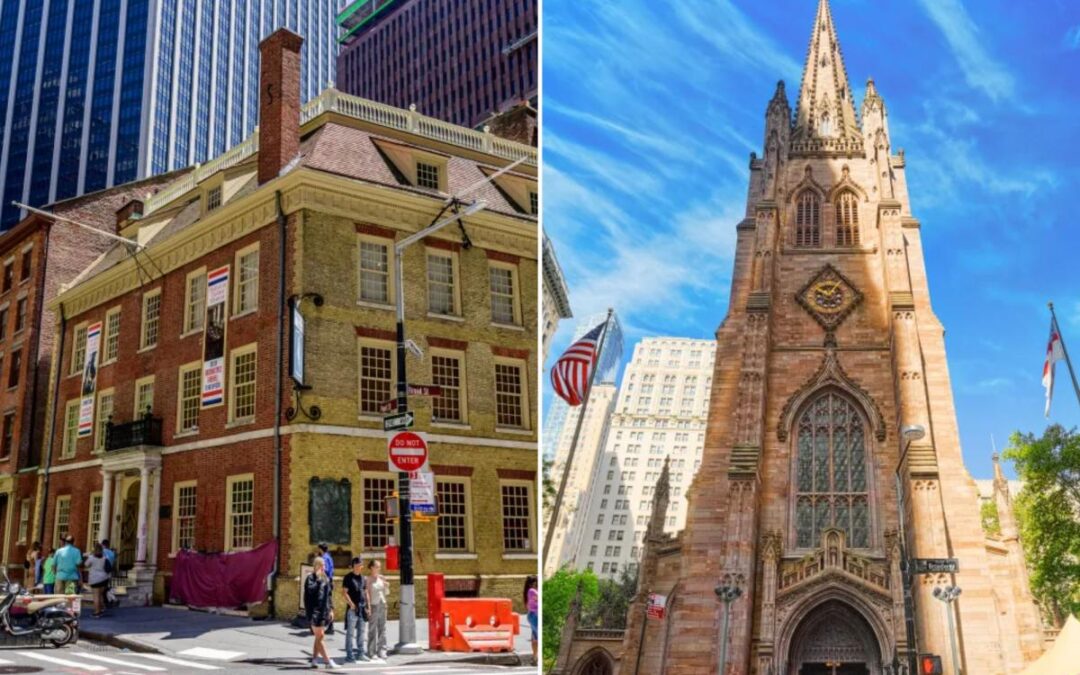
Fraunces Tavern
54 Pearl Street
No visit to Colonial‑era New York City is complete without a visit to Fraunces Tavern on Pearl Street. Samuel Fraunces (or Francis or Frances, depending on the text) was a West Indian man who arrived in New York in the 1760s and ran several successful taverns. In 1762, he purchased the property at 49 Great Dock Street at the corner of Broad Street, the former site of a dance hall.
Though he ran other successful businesses, Fraunces’s — aka the Queen’s Head or the Sign of the Queen — became a magnet for those friendly to the fight for independence.
Its tile‑and‑lead roof saw action in the war, when an 18‑pound cannonball fired from the HMS Asia pierced it in the summer of 1775.
Fraunces offered weekly board for “gentlemen who choose it,” as well as families. The menu: oysters, “all sorts of pickles,” “alamode beef,” pastries, sweet‑meats, jellies, and more, including “necessary articles to set out a des(s)ert.”
Today, the upstairs museum upstairs is worth the price of admission ($10 for adults) and features rotating exhibits in addition to paintings, etchings, and display cases of objects ranging from powder horns and dinnerware to bells, badges, bayonets and broadsides. You can also step into the Long Room, where New York’s Provincial Congress once met and where George Washington bid farewell to his troops in 1783.
Smithsonian’s National Museum of the American Indian
1 Bowling Green
The five‑minute stroll from Fraunces Tavern back to Bowling Green takes you past the Alexander Hamilton US Custom House, home to the Smithsonian’s National Museum of the American Indian. Within those 199‑year‑old walls, you can step further back into Colonial-era history — and the history of “Manahatta” itself.
The role of Native Americans in the Revolutionary War is extensive, and soldiers fought on both sides of the conflict in many significant battles. In the Bronx, for example, Sachem Daniel Niham, his son Abraham and many more members of the “Stockbridge Indian Company” (Stockbridge, Massachusetts, was home to members of the Mahican, Housatonic, Wappinger, Tunxis and Shawnee tribes) lost their lives at the Battle of Kingsbridge at Cortland’s Ridge, or what is now Van Cortlandt’s Park.
Many of the surrounding streets of Lower Manhattan pre-date the arrival of the Europeans, who took advantage of the long-established trade routes and changed their names. The island’s original inhabitants, the Lenape, traded beaver pelts and other goods with the Dutch and, eventually, the British for various goods. The market was so hungry for these seemingly cuddly rodents that they were nearly hunted to extinction. The trade ended, but not before the famed creature lent its name to the thoroughfare still known as Beaver Street.
Astor Place was originally called “Kintecoying,” or “Crossroads of Three Nations,” a spot where representatives from major Native American tribes including the Canarsie, Munsee and Sapohannikan, met regularly. Perhaps the most significant of the routes was the Wickquasgeck Trail. It headed north, passing Bowling Green and the Commons, and was renamed “Broadway.”
African Burial Ground National Monument
290 Broadway
Further north on that New York City thoroughfare is the African Burial Ground. Once known as the “Negroes Burial Ground,” it is the largest known cemetery in the United States, estimated to have seen more than 15,000 burials of both free and enslaved black residents. Both enslaved and free black citizens of New York City — nearly 20% of the total population in the mid-18th century — played crucial roles in early New York.
Enslaved workers built the “wall” that gave Wall Street its name, and constructed Stone Street, the first street in New York to feature paving stones. Free black individuals also farmed, worked in the thriving maritime industry and, of course, fought in the Revolutionary War.
Federal Hall National Memorial
15 Pine Street
After the end of the Revolutionary War, New York City saw the nexus of government centered in Lower Manhattan. Once the US Constitution was accepted and ratified, the city became the seat of government under that all-important document, and the first capital of the United States.
Federal Hall hosted the first presidential inauguration, when George Washington took his oath of office on the balcony on April 30, 1789. Though the original Federal Hall was torn down in 1812, the structure you
see today is in the same spot. Opened in 1842 and originally intended as a US Custom House for the Port of New York, it served several governmental functions over the years before becoming a national memorial, with the iconic statue of George Washington placed on the building’s steps in 1882.
The site is now run by the National Park Service and dedicated to the early history of the US government. The museum’s collection includes the actual bible that Washington used for his inauguration, and which was subsequently used at the inaugurations of Warren G. Harding, Dwight D. Eisenhower, Jimmy Carter and George H.W. Bush. (The bible is not always on display, so inquire before you go.)
St. Paul’s Chapel and Trinity Church
89 Broadway
The year 1776 brought devastation in many forms to a city under siege. Shortly after British troops moved into Manhattan that September, fire ripped through the southernmost tip of the island, destroying up to 25% of the structures. Miraculously, St. Paul’s Chapel — which welcomed its first worshippers in 1766 — survived, thanks in great part to citizens who climbed its roof to douse any burning debris carried on the wind. As such, St. Paul’s is the oldest standing church building in the city today.
During the Revolutionary War, British leaders such as Lord Charles Cornwallis and Sir William Howe worshipped here. George Washington and Congress prayed here after Washington’s inauguration in 1789.
Five short blocks south, Trinity Church did not survive that 1776 fire. Reconstruction was fully completed in 1790, and Washington attended the consecration ceremony. Washington’s aide Alexander Hamilton was laid to rest here following his tragic duel. Hamilton’s widow, Elizabeth, rests here too. Elsewhere on the grounds are the remains of Declaration of Independence signer Francis Lewis of New York; Horatio Gates, the hero of the Battle of Saratoga during the Revolutionary War; and Hercules Mulligan, the tailor-spy who befriended Hamilton and is featured on countless Hamilton T-shirts.
Denise Kiernan is the author of “Obstinate Daughters: The Rebels, Writers, and Renegade Women Who Ignited the American Revolution.”

