
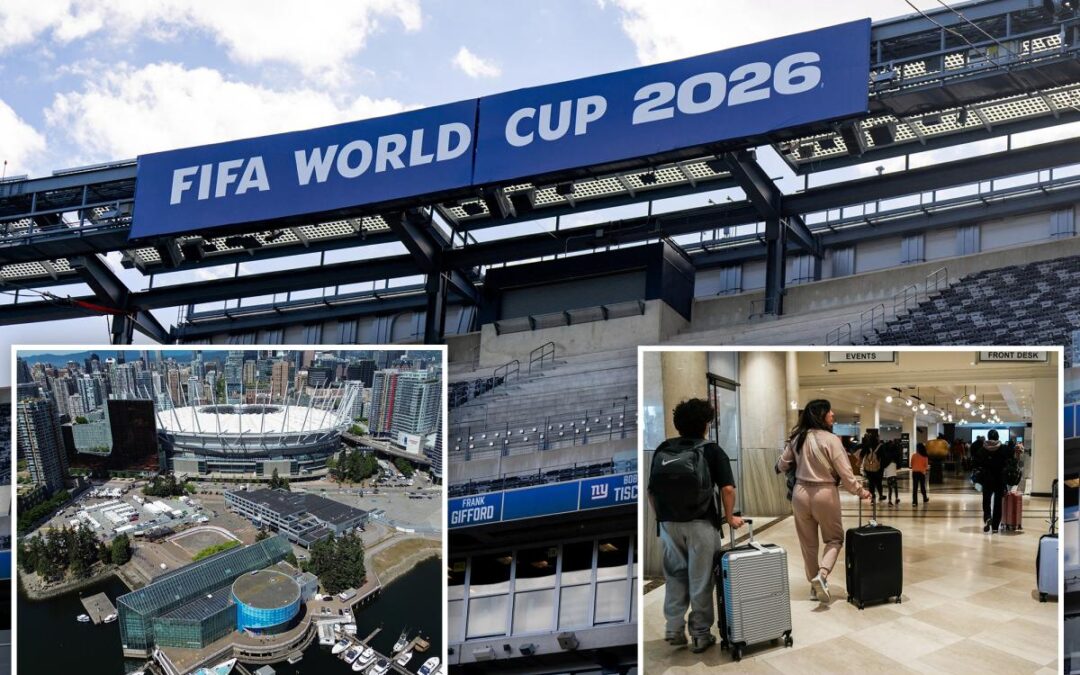
The world may be gearing up for soccer’s biggest spectacle — but hotel rooms across North America are still sitting more empty than expected.
With less than a month until the 2026 FIFA World Cup kicks off, early booking numbers suggest the hospitality industry may have overestimated just how many fans would shell out big bucks to follow the action in person.
Despite the hype surrounding the first-ever 48-team World Cup — expanded to a whopping 104 matches spread across 16 cities — hotel occupancy rates in several host hubs are lagging where they were this time last year, according to data from property analytics firm CoStar.
Some cities are still expected to score big. Mexico City, Monterrey, Dallas and San Francisco have all posted relatively strong booking numbers, per The UK Times.
But elsewhere, the picture looks shakier.
Hotels in Vancouver are averaging just 39% occupancy for match dates, down from 53% at the same point last year. In Boston — where Norway faces Iraq on June 16 — occupancy rates are hovering around 32%, compared to 44% a year ago.
Even the Brazil-Morocco showdown in nearby New Jersey hasn’t given New York City hotels the expected boost. Occupancy rates for June 13 sit around 31%, down sharply from 43% last year.
According to another recent report from the American Hotel & Lodging Association, the early World Cup gold rush may be more mirage than money-maker.
In a survey of hoteliers across 11 host markets — including New York, Boston, Los Angeles, Miami and Seattle — 80% said hotel bookings are tracking below initial forecasts.
About two-thirds of New York City operators reported softer-than-expected bookings, while nearly 80% of hotels in markets like Boston, Philadelphia, San Francisco and Seattle said they are running behind typical summer demand.
Roughly 65% to 70% of respondents pointed to visa hurdles and broader geopolitical concerns as major drags on international demand, while about half reported FIFA room block cancellations that effectively “reset” early booking expectations.
Only about 25% to 30% of markets are seeing any meaningful incremental lift from the tournament, largely those with strong baseline leisure travel or confirmed team base camps.
The sluggish numbers are raising eyebrows as hoteliers brace for what was supposed to be a tourism gold mine.
Jan Freitag, national director of hospitality analytics for CoStar, warned that the tournament could end up being a “tale of two months,” with weaker turnout during the early rounds before demand spikes later in July for the must-watch knockout games.
“For the earlier round games, it is possible that they won’t have the draw that was expected and that implies lower room occupancies,” Freitag said. “There are teams that didn’t qualify four years ago for a reason.”
Freitag pointed to Curaçao — the tiny Caribbean island nation making its World Cup debut — as one example of a team unlikely to trigger a massive wave of traveling American fans.
The mega-tournament arrives as travelers grapple with soaring airfare prices, inflation, and increasingly eye-watering event costs — problems exacerbated by geopolitical tensions overseas.
While past World Cups were held in a single country, the 2026 tournament spans three nations. That makes travel more complicated and costly for fans following teams city to city — while a record 100+ matches may simply be spreading demand too thin.
“Now you have a war going on, and with oil prices up, airfare is more expensive. So even if you thought, ‘oh, I can make a last-minute decision’, the airfare suddenly plays into your calculation,” Freitag said.
REUTERS
Some even called the World Cup a “non-event” once room releases and weak international fan travel were factored in.
President Trump previously denounced sky-high 2026 World Cup ticket prices in an exclusive interview with The Post, saying even he wouldn’t shell out the $1,000 needed to attend the US opener against Paraguay in Los Angeles.
Meanwhile, FIFA president Gianni Infantino has defended the pricing structure, joking at a recent event that resale tickets for the July 19 final at MetLife Stadium were topping $2 million — and promising to personally deliver “a hot dog and a Coke” to any buyer willing to pay it.
He also noted that average final tickets are nearing $13,000, up sharply from about $1,600 in 2022, while some SoFi Stadium seats are listed from $1,079.
Critics say the pricing spree — combined with aggressive resale markets and dynamic pricing — risks shutting out everyday fans, even as FIFA touts “record-setting” demand and more than 5 million tickets already sold.


