
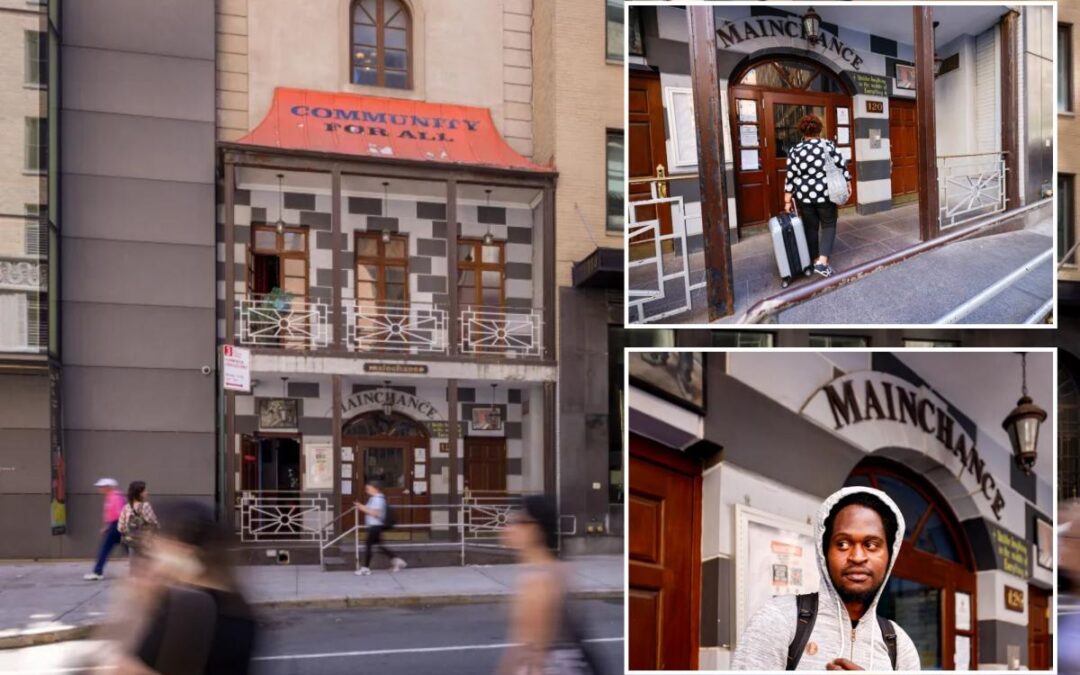
There may be a homelessness epidemic, but New York City’s lefty mayor is leaving those in Midtown East on the streets.
The city announced in April that the Department of Homeless Services would not renew a contract for Mainchance, a homeless drop-in center at 120 E. 32nd St., after its June 30 expiration. The facility is slated to close that day.
“Its clients will be forced to wander the streets, hoping to find shelter at other already crowded facilities in other neighborhoods,” Mainchance says in a newly filed Manhattan Supreme Court petition.
Mainchance received the notice just days after the city sent a letter complaining that Mainchance violated its contract by turning clients away. The facility says it didn’t get a chance to contest the claims or rectify the issues, per court documents.
Mainchance, its not-for-profit operator Grand Central Neighborhood Social Services and one of its clients claim in their petition the infractions are “not a reasonable basis for terminating the Mainchance contract, especially given the absence of any plans by DHS to otherwise provide services for homeless people in this neighborhood being displaced by Mainchance’s closure.”
The matter is already causing concern for homeless individuals who rely on Mainchance’s services.
Fritz Paul, 29, has slept in a chair at Mainchance for about four months as he awaits a housing voucher — and, he said, as he awaits the start of a new job at chicken finger chain Raising Cane’s. News of the closure upsets him.
“In the name of Jesus I’m getting my voucher before this place shuts down,” he told The Post as he entered the drop-in center on Wednesday afternoon.
If he doesn’t receive his voucher, he added, “I don’t know what area they will send me [to].”
For 62-year-old Sherry McLoy, Mainchance “is needed” due to the economy.
“Unless you are wealthy, we are all one paycheck away from my situation,” she told The Post. She lost her husband of 35 years in 2023, then her 34-year-old son to an accidental suicide. “It just snowballed.”
McLoy said she had lived with her husband on Staten Island — and couldn’t handle the rent without him on her paycheck from WeWork where she said she leases space. After some years staying with friends, she came to Mainchance a week ago in order to get a housing voucher.
“Every homeless New Yorker deserves a safe place to stay and access to services to move toward permanent housing,” a City Hall spokesperson told The Post in a statement, but declined to comment on the ongoing litigation. “Delivering on that commitment requires holding providers accountable and ensuring that every shelter operates in full compliance with its obligations. Our review found that Mainchance failed to meet DHS contract requirements and restricted access to essential services, including restroom access and food outside of scheduled meal times. That is unacceptable. As a result, we will not be renewing this contract. We are working closely with Mainchance to ensure a smooth transition and continuity of care for every client.”
Brady Crain, 69, the CEO and executive director of Mainchance, told The Post “that’s not our culture” of restricting restroom use and food outside of meal times. “Every night we have 72 people; other drop-in centers call us because they overflow.”
Crain added no other city drop-in centers are shuttering. A sign posted on the center’s door says clients in need of drop-in centers can go to three others in Manhattan — one at 771 Ninth Ave., Paul’s Place at 114 W. 14th St. and the Olivieri Drop-in Center at 257 W. 30th St. — and that outreach workers will be onsite to offer clients new placements. The Ninth Avenue facility and Olivieri are overseen by Urban Pathways.
“Urban Pathways is aware of the planned closure and is committed to working closely with DSS/DHS and our community partners to better understand the impact on the individuals currently utilizing these services,” it said in a statement. “Our foremost concern is ensuring that vulnerable New Yorkers continue to have access to the care, support and resources they need. We believe any transition should be approached thoughtfully and compassionately, with a focus on continuity of care and minimizing disruption for those experiencing homelessness. As additional information becomes available, we will continue to engage with DSS/DHS to help ensure that the needs of affected individuals are addressed in a caring, compassionate and person-centered manner.”
Paul’s Place did not respond to a message seeking comment.
As this all unfolds, Mainchance’s building — sandwiched between the luxury Marmara Hotel and a Korean Cultural Center — asks $8 million for sale, according to an Avison Young listing. Mainchance occupies the nearly 10,000-square-foot structure on a triple-net lease. The listing is represented by Alex Woodlief and Brent Glodowski — the former of whom was seen on Wednesday bringing clients in for a viewing. Woodlief, a director at Avison Young, denied he was involved with the marketing when The Post approached him for comment.
An effort by the city to shutter Mainchance initially erupted two years ago over allegations of “underperforming” during then-Mayor Eric Adams’ tenure, but a judge ruled the city could not terminate the contract.
The facility, around for 35 years and at its current home since 2005, enrolled 5,800 homeless individuals as “clients” for housing placement services during the first 10 months of this fiscal year, according to court documents, and a total of more than 20,000 customers — some who were repeats — slept overnight in its 72 chairs. There are no beds inside.
The building, which seems to stand three stories tall from the outside, appears to have five or six split levels inside. Caseworkers and administrators are located upstairs; clients are separated by gender. Children can eat inside, but not sleep.
Another 21,000-plus homeless people visited to eat, shower, rest and receive medical and mental health services. DHS allocated Mainchance a $2.8 million budget in fiscal year 2026, representing nearly all of Mainchance’s cash flow.
Mayor Zohran Mamdani abruptly announced in March that the infamous nearby Bellevue — the main intake center for single homeless men — would shut down at 400 E. 30th St. at the end of April because the site was in a “severe state of disrepair.” His administration said its then-250 residents would be relocated to other facilities. Today, that facility still operates on an intake-only basis, according to a source, not as a shelter.
Meanwhile, East Village residents got fired up about a potential onslaught of homeless descending on their neighborhood, to a potential replacement facility on East Third Street. They have sued to prevent the opening of the 117-bed facility in which the Mamdani administration has already poured $1.3 million.


